
Executive Summary
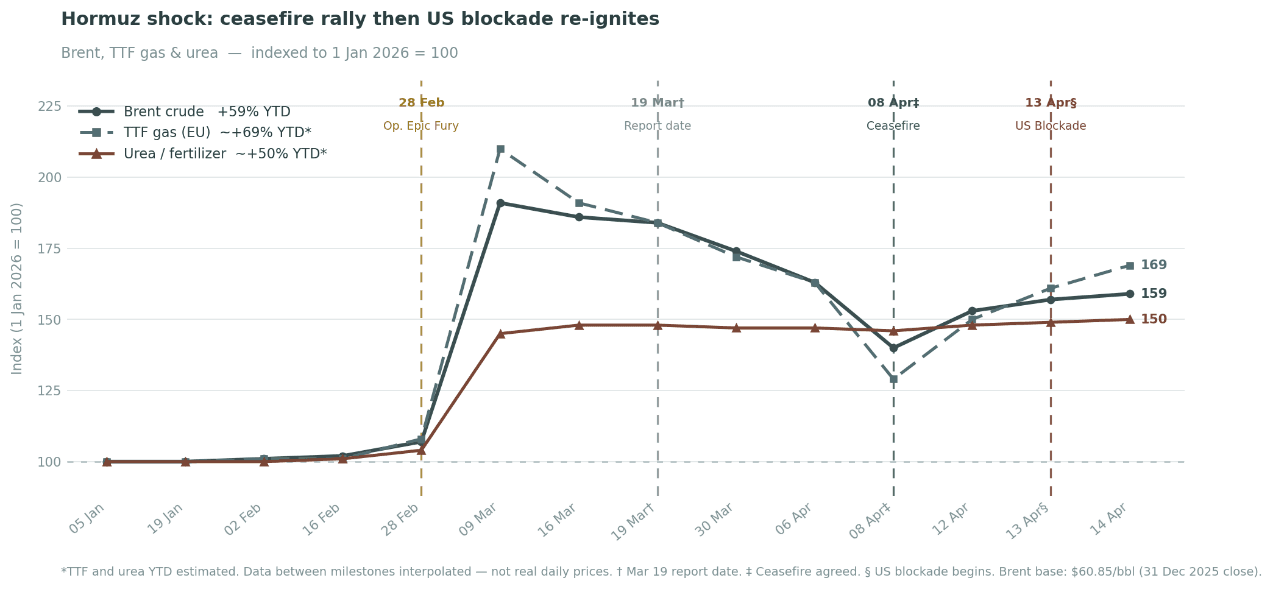
The Iran war has entered a more dangerous and structurally entrenched phase since the March 19 report. A 2-week ceasefire agreed on 8 April, brokered by Pakistan, collapsed within 72 hours: Israeli strikes in Lebanon triggered fresh Hormuz closures, direct US-Iran talks in Islamabad failed on 12 April after 21 hours, and on 13 April the United States imposed a naval blockade of Iranian ports and coastal areas. The two-week ceasefire technically expires on 21 April. Brent, which briefly plunged 13% on ceasefire euphoria to approximately $85-86, has recovered to approximately $97/bbl, still ~+59% year-to-date from the January 1 closing price of $60.85, and the stagflationary impulse first identified in the March report is now confirmed in hard data.
Three major data releases have sharpened the macro picture. US March CPI printed +3.3% year-on-year (+0.9% MoM), the largest monthly increase since June 2022, driven by a 21.2% surge in gasoline prices, confirming the full energy pass-through is now visible in the data. March non-farm payrolls surprised at +178,000, the strongest print since December 2024, but the headline warrants scepticism: February was simultaneously revised down by 41,000 to -133,000, healthcare accounted for 76,000 of March's gains as a mechanical reversal of the Kaiser Permanente strike, and the underlying labour market trend remains fragile. On 12 April, Viktor Orbán conceded defeat in Hungary's parliamentary election after 16 years in power. Péter Magyar's Tisza party won a two-thirds supermajority (138 of 199 seats, 53.6% of votes, record approximately 80% turnout), removing the EU's most consistent internal veto and opening the path for €90bn in EU Ukraine funding previously blocked by Budapest.
EUR/USD is essentially unchanged on the year — notable because in prior geopolitical crises, the dollar has surged as the default safe-haven (DXY spiked sharply in both Russia-Ukraine 2022 and COVID 2020). That this has not occurred in 2026 is a structural signal: markets are discounting US fiscal and political trajectory more than they are rewarding the dollar for safety.
Key Takeaways
- Iran war: ceasefire collapsed, US naval blockade active since April 13. Hormuz effectively closed. 2-week ceasefire expires April 21. Next critical window: talks before expiry.
- US CPI March: +3.3% YoY / +0.9% MoM, largest monthly gain since June 2022. Full energy pass-through confirmed in hard data. Core at 2.6% contained; headline projected at 3.5-3.6% by May (EY).
- US Jobs March: +178K beats consensus of 59K, but February revised to -133K and healthcare adds 76K as Kaiser strike reversal. Underlying trend weaker than headline implies.
- Hungary: Orbán defeated April 12. Tisza supermajority (138/199 seats). EU-Ukraine €90bn loan path now open; EU structural funds unlockable.
- Dollar fails safe-haven bid: EUR/USD essentially flat YTD. Structural US confidence discount persists.
Market Sentiment & Asset Overview
Cross-asset dynamics have entered a second, more volatile phase of repricing. The April 8 ceasefire triggered an immediate violent re-rating: Brent crashed 13%, the S&P 500 had its best day in a year, and Treasury yields fell sharply. This was followed by a near-complete reversal within days as the ceasefire unravelled and the US announced the naval blockade. Markets are navigating compound uncertainty: a war that will not end cleanly, a US labour market that distorts its own signal, and a dollar that refuses to rally even as US inflation runs above 3%.
The most striking cross-asset observation is the dollar's failure to attract its normal geopolitical premium. EUR/USD is essentially unchanged on the year. In prior crises such as Russia-Ukraine 2022 and COVID 2020, the DXY surged. Its flat-to-weak performance in 2026 signals that markets are pricing US structural headwinds, including fiscal trajectory, stagflation risk, and the Fed Chair transition in May, more than they are rewarding the dollar for safety. The Euro Stoxx 50's YTD gain of +2.6% from the confirmed January 1 close of 5,791 represents a significant correction from its February peak of approximately 6,174 (+6.6% YTD at that point), driven by the Iran energy shock hitting European confidence. Gold at $4,748/oz remains elevated but has retreated from its March conflict-peak of approximately $4,880. VIX at approximately 19.1 has moderated from its 35+ peak as acute panic has subsided.
| Asset Class | Current Level | Change | Signal |
|---|---|---|---|
| S&P 500 | ~6,967 | ~1.8% YTD | ↑ Recovered; Iran losses wiped out |
| Euro Stoxx 50 | ~5,940 | -0.3% MoM | ↑ Resilient |
| 10Y UST Yield | ~4.31% (Apr 10, last trading day) | +9bp vs Mar 19 | ↑ Rising |
| DXY (USD Index) | ~98.1 | -1.8% MoM | ↓ Structurally weak |
| Brent Crude | ~$97/bbl | -$15 / -13.4% MoM | ↑ Ceasefire dip reversed |
| Gold | ~$4,748/oz | -$132 / -2.7% MoM | ↑ Elevated; off peak |
| VIX | ~19.1 | Down from 35+ conflict peak | ↓ Fear moderating |
| BTC/USD | ~$74,400 | -0.8% vs Mar 19 | ↑ Recovering; Iran losses largely reversed |
Business Cycle Positioning
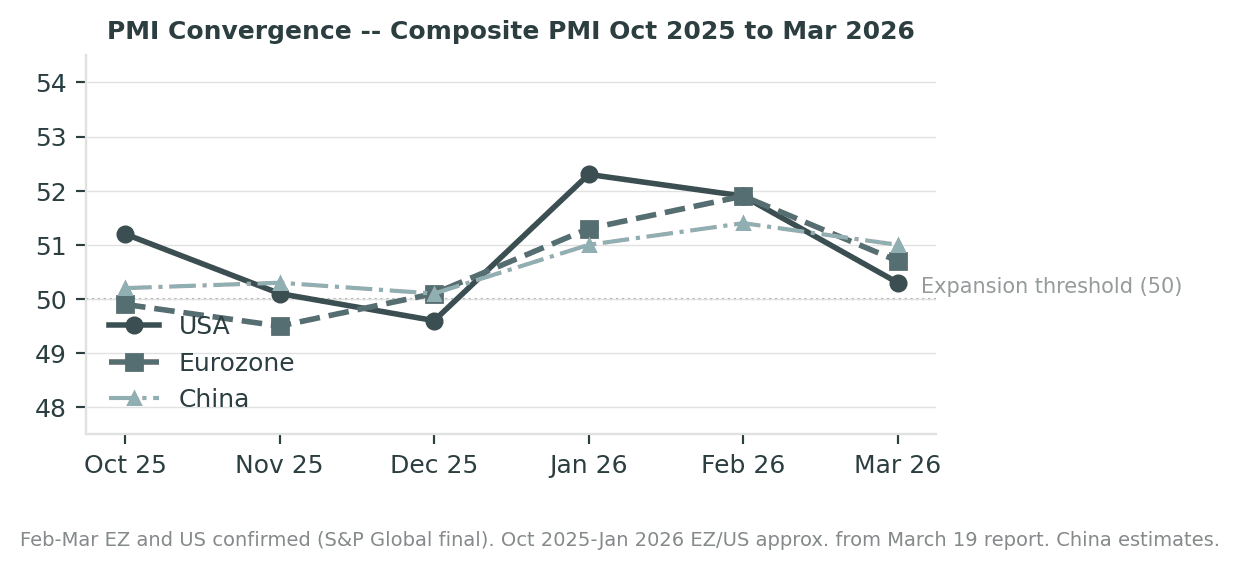
The PMI convergence that defined the March report's narrative has partially unwound, but not in the direction optimists hoped. Both the US and Eurozone composite PMIs fell in March: the US to 50.3 and the Eurozone to 50.7, converging near the expansion threshold as the Iran shock hit business confidence in both blocs simultaneously. The US services sector contracted outright in March (49.8), its first contraction since September 2023, signalling that the consumer is beginning to absorb the energy shock. Eurozone manufacturing held firmer (51.6, a 4-year high, driven by German defence and infrastructure orders), but services nearly stalled (50.2) as confidence hit a 10-month low.
The US stagflation thesis is now confirmed in hard data across every key metric: Q4 2025 GDP at 0.7% annualised, Q1 2026 GDPNow tracking 0.5-1.0%, and CPI confirmed at 3.3% with more energy pass-through ahead. China holds at an estimated composite PMI of approximately 51 with resilient services, but as the world's largest net oil importer shares the US growth-headwind direction rather than the commodity-export windfall profile of Gulf states or Brazil. Japan's manufacturing remains at a 45-month high with wage growth above 3%, meeting the BoJ's normalisation prerequisites.
| Region | Cycle Phase | Key Indicator | Direction |
|---|---|---|---|
| USA | Late Cycle / Stagflation Risk | CPI 3.3%; NFP +178K (distorted); UE 4.3% | ↓ Deteriorating |
| Eurozone | Mid-Cycle (Energy headwind) | Composite PMI 50.7 (Mar); EZ50 +2.6% YTD | ↑ Resilient but slowing |
| China | Subdued Recovery | Services PMI >52; Mfg ~50; oil headwind | → Stable |
| Switzerland | Moderate Expansion | KOF improving; CPI ~0.5%; CHF safe-haven | → Neutral |
| Japan / Asia ex-CN | Recovery | Mfg PMI 45-month high; wage growth >3% | ↑ Improving |
| Emerging Markets | Mixed / Diverging | Commodity exporters vs net importers | ↓ Diverging |
Special Focus: Iran War — Ceasefire Collapse, US Naval Blockade & the Hormuz Endgame
The Iran war has entered what analysts are calling its endgame phase, with no clarity on whether that endpoint is a lasting agreement or wider escalation. On 8 April a 2-week ceasefire was agreed, mediated by Pakistan. Tehran committed to reopening the Strait of Hormuz and Washington suspended strikes. Within hours the agreement frayed: Israeli airstrikes in Lebanon, which Netanyahu explicitly excluded from the ceasefire scope, prompted Iran to halt Hormuz traffic again. Brent, which had collapsed 13% on the ceasefire announcement, began recovering within 24 hours.
Talks in Islamabad on 12 April, the highest-level US-Iran direct engagement since the 2015 nuclear deal, failed after 21 hours. JD Vance departed without agreement. Tehran demanded control of the Strait, war reparations, and a broader ceasefire including Lebanon. Washington required a complete halt to nuclear enrichment and limits on ballistic missiles. On 13 April, Trump declared a US naval blockade of Iranian ports, stating US forces would interdict any vessel that had paid Iran's Hormuz transit toll. Simultaneously, CENTCOM began minesweeping operations, with reports indicating Iran had lost track of some of the mines planted since February 28. As of 14 April, three ships have passed through under US escort, but commercial operators and underwriters have not cleared regular transits.
Energy market consequences remain the defining macro fact of April. Brent, which dipped to approximately $85-86 at the ceasefire low, has recovered to approximately $97 as the blockade premium was re-added. Saudi Arabia's East-West bypass pipeline handles approximately 4.5m bpd but cannot offset the 12-15m bpd that normally transited Hormuz. Iranian strikes on Saudi energy infrastructure have taken an estimated 600,000 bpd of Saudi capacity offline. OPEC+ total output fell 7.9m bpd in March, the largest supply disruption on record. The ceasefire technically expires 22 April. Both sides have signalled willingness to resume talks but on mutually incompatible terms.
The fertilizer crisis flagged in the March report has fully materialised. Urea at the New Orleans import hub remains approximately $683/tonne, roughly +47% above the January 1 baseline of approximately $465, and the Northern Hemisphere spring planting window is actively running through May. The USDA Prospective Plantings report released on March 31 showed corn acreage intentions falling 3.5% to 95.3 million acres as farmers pivot to less fertilizer-intensive soybeans. This will reduce corn-based livestock feed and ethanol supply in H2 2026, creating a food inflation tail that persists beyond any Hormuz resolution.
Regional Overviews
The regional picture has evolved materially since March 19. US stagflationary risk is now confirmed by hard data; the Eurozone is absorbing the energy shock from a position of fiscal strength while gaining a historic political tailwind from Hungary's transition; and Switzerland remains squeezed between safe-haven franc appreciation and weakening export demand. Regions are presented in order of analytical priority from our Swiss home base.
United States
Growth — The stagflation thesis is now in the hard data. Q4 2025 GDP: 0.7% annualised; Q1 2026 GDPNow tracking 0.5-1.0%. February payrolls were revised to -133,000, making March's +178,000 a volatile bounce driven largely by the reversal of the Kaiser Permanente healthcare strike. Federal headcount is down approximately 355,000 (11.8%) since the October 2024 peak. Consumer confidence hit a record low in April.
Monetary Policy — The Fed holds at 3.50-3.75%. March CPI at 3.3% YoY keeps the 2% target further from reach; core at 2.6% remains contained for now. Fed futures price approximately 8bp of cuts by year-end. FOMC minutes flagged bimodal risks: some members see a case for rate hikes if inflation persists; others cite labour softening as a cut catalyst. Powell's term ends in May, adding a credibility uncertainty premium at the worst possible moment.
Key Risk / Watch — April CPI (May 12) is the next critical reading. Watch for headline approaching 3.5% and core PCE above 2.8%. The April 28-29 FOMC should be watched for any language shift on stagflation risk.
Switzerland
Switzerland sits at the intersection of the two dominant macro forces of 2026, the Iran safe-haven bid and the European fiscal recovery, making it simultaneously a beneficiary of institutional confidence and a victim of structural export headwinds.
Growth — KOF still forecasts 2026 GDP at 1.1-1.9%, but the confidence interval has widened materially. Safe-haven flows have intensified since March, further compressing export sector margins. Novartis and Roche, with a combined market cap exceeding CHF 400bn, generate most revenues in USD and EUR while reporting in CHF; continued franc strength structurally compresses reported earnings. Swiss CPI at approximately 0.5% YoY remains the global inflation anomaly: while the US fights 3.3% CPI, CHF appreciation and energy import diversification are producing net disinflationary pressure in Switzerland.
Monetary Policy — The SNB held at 0% on March 19, having completed 175bp of easing since March 2024, the most aggressive G10 easing cycle in relative terms. The next scheduled meeting is June 19, 2026, a 13-week gap that elevates the probability of unscheduled FX intervention if EUR/CHF appreciation continues. Schlegel explicitly flagged increased intervention readiness at the March meeting.
Key Risk / Watch — EUR/CHF trajectory is the single most important Swiss variable. The historical SNB intervention threshold sits around EUR/CHF 0.90-0.92. Any ceasefire and Hormuz reopening is the most powerful CHF-weakening catalyst, simultaneously removing safe-haven demand, lowering energy prices, and improving eurozone growth expectations. Monitor Schlegel statements ahead of the June 19 SNB meeting.
Eurozone
The Eurozone enters the war's second phase from a position of relative strength and with a significant new political tailwind. Orbán's defeat in Hungary on April 12 is a genuine structural positive: it removes the EU's most persistent internal veto, unlocks the €90bn EU loan to Ukraine previously blocked by Budapest, and signals a broader normalisation of European institutional coherence.
Growth — Composite PMI fell to 50.7 in March from 51.9 in February as the energy shock began to bite, but the bloc remains in expansion. Germany's €127bn fiscal package continues to flow through with defence spending acceleration, infrastructure investment, and energy transition subsidies. Eurozone unemployment remains near record lows; inflation had slipped below the ECB's 2% target in January, meaning the energy shock arrives from a lower base than in the US. The Euro Stoxx 50 has corrected from its February peak of approximately 6,174 to approximately 5,940, representing +2.6% YTD from the confirmed January 1 close of 5,791, as energy shock headwinds have weighed on confidence.
Monetary Policy — The ECB holds at 2.00% (deposit rate), its sixth consecutive pause since the June 2025 cut. Updated March projections revised 2026 inflation up to 2.6% and cut 2026 GDP to 0.9%. With EUR/USD holding at approximately 1.17, the euro's strength provides a natural disinflationary offset on energy imports. Next ECB meeting: April 30, 2026.
Key Risk / Watch — The April 30 ECB meeting will be the first to include updated projections incorporating the full energy pass-through visible in data. Watch for growth downgrade language. The primary downside risk is sustained $100+ Brent severe enough to force the ECB to choose between growth support and inflation containment. Hungary's government formation adds short-term governance uncertainty as Magyar transitions into office.
China
Growth — China holds at an estimated composite PMI of approximately 51, with services resilient and manufacturing stable. As the world's largest net oil importer, China shares the US growth-headwind direction. Domestic deflation persists and the property sector remains a structural drag. CNY strength versus USD provides partial energy cost offset.
Monetary Policy — The PBOC maintains its easing bias through cross-cyclical policy tools. Fiscal stimulus pledges are constrained by debt sustainability. A prolonged Hormuz blockade at $90+ Brent is a material headwind to the recovery trajectory.
Key Risk / Watch — Domestic deflation compounded by external energy shock. Monitor April PMI data and any NPC supplementary budget announcements. US-China semiconductor export controls remain a medium-term overhang.
Japan & Asia ex-China
Growth — Japan's manufacturing PMI remains at a 45-month high; wage growth above 3% meets the BoJ's normalisation prerequisite. USD/JPY near 145-155 is double-edged: supportive for exports but feeding imported inflation on $90+ oil. The US consumer slowdown creates a secondary headwind for Asia ex-China exporters.
Monetary Policy — The BoJ continues gradual normalisation with JGB yields rising more freely post-YCC exit. A disorderly yen depreciation beyond 160 versus USD could force emergency BoJ action, a repeat of the August 2024 carry-trade unwind when VIX briefly spiked to 64.
Key Risk / Watch — JPY trajectory is the key variable. Monitor BoJ guidance and USD/JPY at each FOMC meeting.
Emerging Markets
Growth — The EM complex experiences its sharpest divergence since 2014-16: Brazil, Gulf states, and Nigerian energy names benefit from elevated Brent; ASEAN, South Asia, and African oil importers face deteriorating terms of trade and potential balance-of-payments stress.
Monetary Policy — Brazil's BCB has been hiking; India's RBI is cautiously neutral; ASEAN broadly accommodative. Sustained $90+ Brent creates upward inflation pressure across the board, and further USD strengthening compounds the shock for dollarised debt holders.
Key Risk / Watch — Monitor EM sovereign spreads, particularly frontier markets with heavy oil import exposure. Long GCC equities and Brazilian energy names remain the most direct Brent exposure.
Outlook & Key Risks
Base Case (50%) — April 22 ceasefire expiry triggers renewed mediated talks. Pakistan and China jointly broker a 30-day extension allowing partial Hormuz reopening to non-belligerent vessels. Brent settles in the $88-100 range. The Fed holds at 3.50-3.75% through at least June with no cuts in 2026. US GDP tracks 1.0-1.5% annualised in H1, soft but not recessionary. EUR/USD holds at 1.14-1.18. Gold above $4,500. VIX in the 18-22 range.
Upside Risks (20%) — A lasting ceasefire and agreed Hormuz reopening mechanism would see Brent retreat toward $75-82, restoring Fed cut optionality and triggering a rally in rate-sensitive equities. The Eurozone benefits most: German fiscal expansion combined with lower energy costs represents a genuine mid-cycle acceleration. EUR/USD could test 1.20-1.22. Gold corrects toward $4,200-4,400.
Downside Risks (30%) — US-Iran naval engagement escalates; Hormuz remains closed through Q2; Brent returns to $110-120+. US headline CPI reaches 4%+, eliminating Fed cut options and introducing a credible probability of rate hikes. US GDP contracts in Q2-Q3 as the consumer buckles. The BoE's private credit warning materialises into forced liquidations and public credit spread widening. EUR/USD reverses toward 1.10-1.12. Gold re-tests $5,000. Downside probability has been raised by 5 percentage points from the March report, reflecting the ceasefire failure and US blockade escalation.
| Metric | Base Case (50%) | Upside (20%) | Downside (30%) |
|---|---|---|---|
| Brent Crude | $88-100/bbl | $75-82/bbl | $110-120+/bbl |
| S&P 500 | Flat to −5% | Rally +8–12% | -12 to -18% |
| Fed Path | Hold, no cuts 2026 | 1-2 cuts H2 2026 | Hold / possible hike |
| EUR/USD | 1.14-1.18 | 1.20-1.22 | 1.10-1.12 |
Key Dates & Events
| Event | What to Watch |
|---|---|
| 22 Apr — Ceasefire expiry | Resumption of talks vs renewed hostilities is the single largest near-term market binary. |
| 28-29 Apr — FOMC | Expected hold. First meeting since March CPI at 3.3%. Powell's final meeting before May term end. |
| 30 Apr — ECB | First meeting since March 19. Updated projections incorporating full energy pass-through data. |
| 12 May — US CPI (Apr) | EY projects 3.5-3.6%. Determines Fed June meeting pricing. |
| 19 Jun — SNB | 13-week gap since March 19. Elevated probability of unscheduled intervention before this date. |
| Ongoing — Iran / Hormuz | Any Hormuz reopening is the dominant Brent, CHF and global risk sentiment catalyst. |
Prepared by Tristan Sommer · Investment Club Zurich — Macro Team · 16 April 2026 · Sources: Federal Reserve, ECB, SNB, BLS (Employment Situation March 2026), S&P Global PMI, EY (US CPI March 2026), TD Economics (US CPI March 2026), Reuters, CNBC, Al Jazeera, NPR, Bloomberg, tradingeconomics.com, FRED / St. Louis Fed, Bank of England Financial Policy Committee (April 2026 update), DTN Progressive Farmer, Wikipedia (2026 Hungarian parliamentary election), CNN, PBS NewsHour.