
Executive Summary
The Iran war is the defining macro event of 2026: the Strait of Hormuz blockade has engineered a stagflationary supply shock that simultaneously raises inflation and destroys growth, leaving every major central bank without a clean policy response. On 28 February, US and Israeli forces launched coordinated US-Israeli strikes, prompting Tehran to restrict shipping through the Strait — the artery through which approximately 20% of global seaborne oil and LNG flows. Brent crude surged from ~$75 to an intraday peak near $116 before retreating toward $100–$105 as early diplomatic signals emerged over the weekend of 14–15 March.
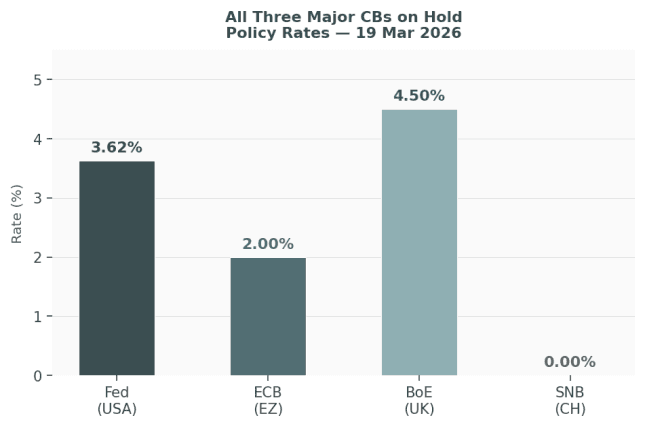
The stagflationary transmission is now confirmed in hard data and in central bank action. The Fed held at 3.50–3.75% on 18 March as widely expected — its dot plot retained one 2026 cut but raised the PCE inflation forecast to 2.7%, with Powell explicitly acknowledging downward pressure on growth and upward pressure on prices from the oil shock, while declining to use the word stagflation. The ECB held at 2.00% today (19 March) and the SNB also confirmed its hold at 0% this morning — completing a synchronised three-way pause that confirms no major central bank has room to ease while Brent trades above $110. Notably the SNB revised its 2026 inflation forecast up to 0.5% from 0.3%, reflecting energy shock pass-through.
The dominant tail risk is whether the Strait disruption becomes entrenched. A prolonged blockade at $110+ Brent would embed inflation, remove all room for Fed easing, and push a softening US labour market toward outright contraction. The Eurozone — benefiting from German fiscal expansion and ECB rates already at neutral 2.00% — stands out as the relative macro bright spot, while Switzerland's safe-haven franc appreciation presents a structural challenge for its export sector.
Key Takeaways
- Iran war = stagflation risk: the Strait of Hormuz blockade simultaneously threatens higher inflation and weaker growth, constraining all major central banks.
- Fed held at 3.50–3.75% on 18 March: dot plot retained one 2026 cut but PCE forecast raised to 2.7% — Powell refused the stagflation label while acknowledging downward growth pressure.
- Eurozone is the relative bright spot: German fiscal expansion, composite PMI at 51.9, and ECB rates at neutral give Europe more policy buffer than the US.
- Three-way pause confirmed: Fed (18 Mar), ECB (19 Mar), and SNB (19 Mar) all held — the most synchronised central bank hold since 2023, all paralysed by the same stagflationary oil shock.
Market Sentiment & Asset Overview
Risk appetite is fracturing along a clear US-versus-Europe fault line: the Iran shock has repriced American assets to reflect stagflation while European equities are repricing a German fiscal dividend, producing the most divergent cross-asset environment since 2022. The Iran war triggered an immediate VIX spike above 35 and a sharp equity selloff before partial stabilisation as diplomatic signals emerged. Markets are in a second-stage recalibration: the initial panic has partially subsided, but persistent $100+ energy prices continue to weigh via the inflation channel.
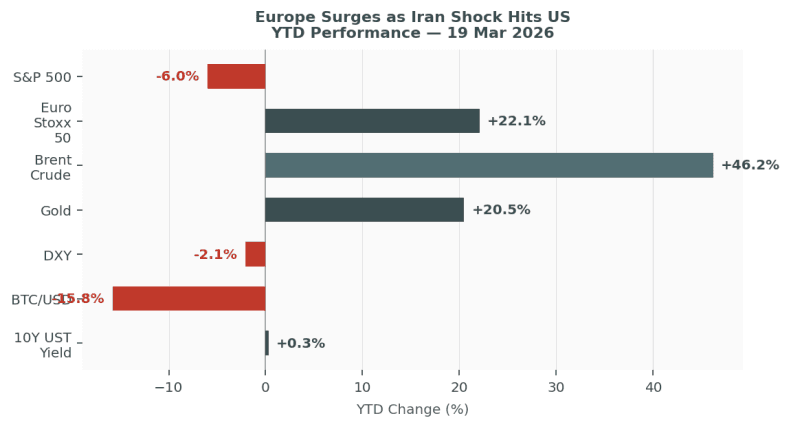
The sharpest cross-asset divergence is Europe versus the US: Euro Stoxx 50 +22% year-to-date driven by Germany's fiscal expansion and ECB at neutral 2.00%, versus S&P 500 down roughly 5% as stagflation risk builds. The 10Y UST yield at 4.22% reflects inflation repricing, not a hawkish Fed pivot. Gold near $4,880/oz and BTC at $75,000 (fuelled by $1.3bn in ETF inflows this month) confirm the risk-off regime — safe-haven and real assets outperforming financial assets. The DXY's decline to ~99.9 signals a structural confidence discount on US growth, not merely a technical move.
| Asset Class | Current Level | MoM Change | Signal |
|---|---|---|---|
| S&P 500 | ~6,680 | ~−6% YTD | ↓ Under pressure |
| Euro Stoxx 50 | ~5,915 | +22% YTD | ↑ Risk-On / outperform |
| 10Y UST Yield | 4.22% | +13bp (week) | ↑ Rising |
| DXY (USD Index) | ~99.9 | −0.5% (week) | ↓ Weakening |
| Brent Crude | ~$112/bbl | +46% YTD (+50% from pre-war) | ↑ Geopolitical premium |
| Gold | ~$4,880/oz | +YTD highs | ↑ Safe-haven bid |
| VIX | ~23.5 | Near 1Y high | ↑ Elevated fear |
| BTC/USD | ~$75,000 | +8.6% (7d) | ↑ Institutional bid |
Business Cycle Positioning
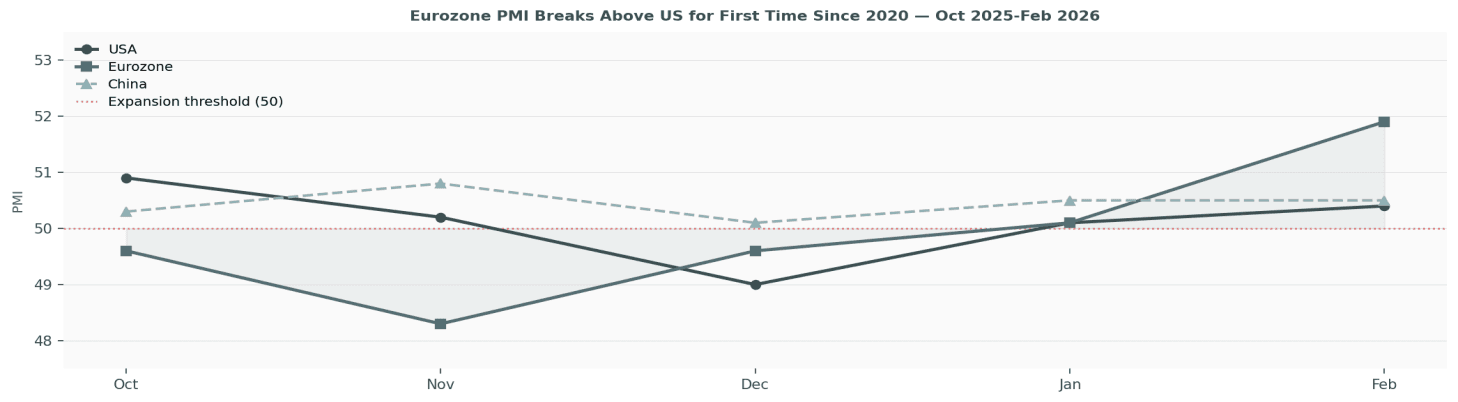
The global cycle is bifurcating in real time: the US is tipping from late-cycle into a stagflationary configuration, while the Eurozone's PMI trajectory — now above the US for the first time since 2020 — signals a genuine mid-cycle recovery decoupling from American weakness. The US exhibits late-cycle characteristics across every key metric: Q4 2025 GDP revised to 0.7% annualised, February payrolls negative, PCE at 2.9%, and the yield curve steepening as energy-driven inflation expectations push long rates up while growth concerns anchor the short end.
The Eurozone is the contrarian story: composite PMI at 51.9, Germany's €127bn fiscal expansion flowing through, and the ECB at a neutral 2.00%. China holds at PMI ~50 in manufacturing and above 52 in services, with the PBOC easing bias intact — but elevated oil is a headwind for a large net importer. Japan's manufacturing PMI hit a 45-month high in February. Emerging markets face the sharpest divergence: commodity exporters in LatAm and EMEA benefit from the oil shock while ASEAN and South Asian net importers face deteriorating terms of trade.
| Region | Cycle Phase | Key Indicator | Direction |
|---|---|---|---|
| USA | Late Cycle / Stagflation Risk | PCE 2.9%; GDP Q4 0.7%; UE 4.4% | ↓ Deteriorating |
| Eurozone | Mid-Cycle Recovery | Composite PMI 51.9 (3M high) | ↑ Improving |
| China | Subdued Recovery | NBS Mfg PMI ~50; Services >52 | → Stable |
| Switzerland | Moderate Expansion | KOF improving; CPI ~0.5% | → Neutral |
| Japan / Asia ex-CN | Recovery | Japan Mfg PMI 45-month high | ↑ Improving |
| Emerging Markets | Mixed / Diverging | Commodity exporters vs importers | ↓ Diverging |
Special Focus: Iran War, Strait of Hormuz & the Global Energy Shock
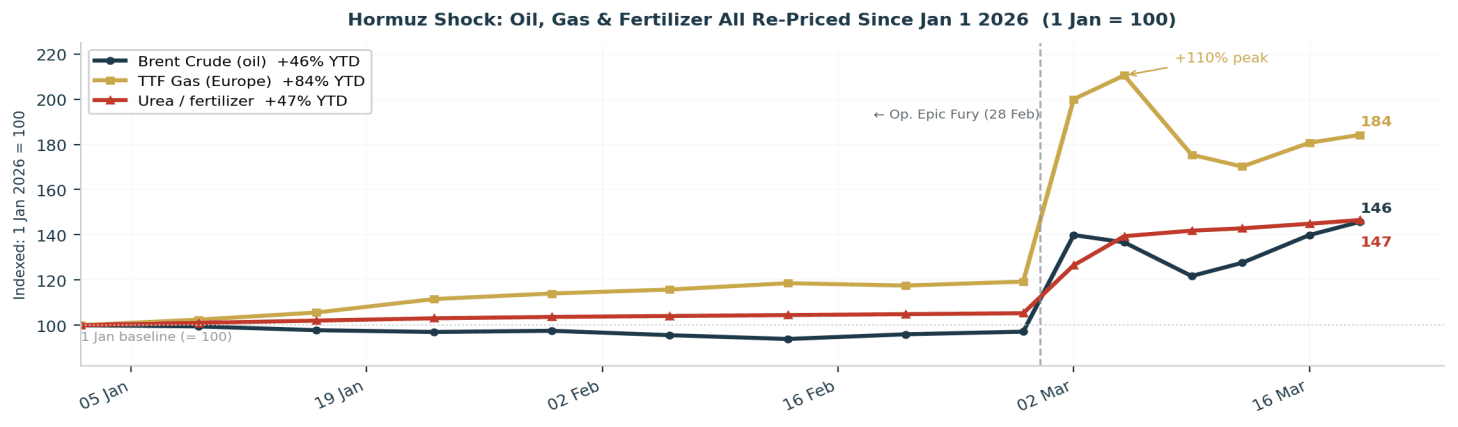
The Strait of Hormuz blockade is widely described as the most significant energy supply disruption since at least the 1990–91 Gulf War, and it has arrived into an economy already exhibiting late-cycle fragility. On 28 February 2026, US and Israeli forces launched coordinated US-Israeli strikes, prompting Tehran to restrict shipping through the Strait — the artery through which ~20% of global seaborne oil and LNG normally flows. Brent surged from $75 to a $126 intraday peak before retreating to ~$112; European TTF gas peaked +110% from its January level before partially settling; and urea fertilizer — of which the Gulf supplies 49% of global seaborne exports — has risen 39% YTD with no relief mechanism, threatening a food inflation tail as the Northern Hemisphere spring planting window runs through May.
The macro transmission operates through three channels. First, direct inflation: US gasoline prices surged ~22% immediately post-blockade, adding 0.4–0.6pp to near-term headline CPI, with energy costs feeding into transportation, food, and manufacturing over a 3–6 month horizon. Second, the growth drag: higher energy costs compress real disposable income and corporate margins simultaneously — leaving the FOMC with little choice but to remain on hold until it is evident whether growth or inflation is damaged more significantly. Third, financial conditions tightening: VIX above 35 at peak and the S&P 500 down ~8% from its February high represent de-facto tightening equivalent to ~75–100bp without any central bank action.
The US holds 400 million barrels from the Strategic Petroleum Reserve as a buffer, but SPR releases are a temporary dampening tool. Powell's dual mandate is directly in conflict — cutting risks embedding inflation, holding risks deepening the slowdown — and his final months as chair before his expected successor's confirmation add a leadership uncertainty premium. Meanwhile, accelerating NATO rearmament commitments represent a structural fiscal impulse across Europe that is a direct beneficiary of the same shock hurting US consumers.
A secondary shock that markets are underpricing is fertilizer. The Gulf supplies ~49% of globally traded urea and 30% of ammonia — both derived from natural gas — and there is no bypass pipeline equivalent to Saudi Arabia's oil route around Hormuz. Urea at the New Orleans import hub jumped 32% in a single week to $683/tonne, hitting farmers entering the Northern Hemisphere spring planting window (March–May). Unlike the oil shock, there is no strategic reserve to release and no quick rerouting option, meaning a food inflation tail from lower H2 2026 crop yields is building quietly behind the headline energy numbers.
Regional Overviews
The regional picture has never been more differentiated: the US faces stagflationary deterioration, Europe is experiencing a once-in-a-decade fiscal dividend, and Switzerland — as the safe-haven recipient of geopolitical flight capital — sits at the intersection of both macro forces. Regions are presented in order of analytical priority given our Swiss home base.
United States
Growth — The US economy entered 2026 already exhibiting late-cycle fragility, and the Iran shock has applied a stagflationary accelerant to deteriorating fundamentals. Q4 2025 GDP was revised to 0.7% annualised — the weakest since pandemic distortions — while February payrolls turned negative and unemployment climbed to 4.4%. Consumer spending faces dual compression: PCE at 2.9% YoY eroding real purchasing power while $100+ Brent raises transportation and utility costs. The Atlanta Fed GDPNow model tracks Q1 2026 at 0.5–1.0% annualised — soft but not technically recessionary. This deterioration creates a spillover channel into Asia ex-China, where export dependency on the American consumer represents meaningful downside if the US labour market continues to soften.
Monetary Policy — The Fed holds at 3.50–3.75% but its framework is functionally paralysed: it cannot cut without risking inflation embedding, and it cannot hike without accelerating the growth slowdown. The 18 March dot plot may remove the single pencilled-in 2026 cut as the Committee confronts 2.9% PCE alongside a negative payrolls print — the definition of a dual-mandate conflict. Markets have already done some of the Fed's work: the VIX spike above 35 and the ~8% S&P 500 drawdown represent de-facto tightening worth an estimated 75–100bp in equivalent rate impact. Powell's term ends in May; the upcoming Fed leadership transition adds a credibility uncertainty layer at the worst possible time.
Key Risk / Watch — With the 18 March FOMC now concluded, focus shifts to April CPI/PCE — the first readings incorporating the full energy shock pass-through. Watch for headline CPI above 3.5% and core PCE above 3.0%, which would effectively eliminate the remaining 2026 cut from market pricing. Powell's tenure ends in May; any news on the Fed leadership transition will move both rates and equities.
Switzerland
Switzerland sits at the intersection of the two dominant macro themes of 2026 — the Iran safe-haven bid and the European fiscal recovery — making it simultaneously a beneficiary of institutional confidence and a victim of structural export headwinds.
Growth — KOF forecasts 2026 GDP growth of 1.1–1.9%. However, safe-haven flows from the Iran shock have amplified CHF appreciation beyond what export sector competitiveness can comfortably absorb. Novartis and Roche — combined market cap exceeding CHF 400bn — generate the majority of revenues in USD and EUR while reporting in CHF; each percentage point of CHF appreciation compresses reported earnings by roughly 0.8–1.0%. ABB and the precision machinery sector face the same dynamic, with CHF cost bases competing against euro and dollar-priced rivals. Swiss CPI at ~0.5% YoY is one of the most striking global anomalies of 2026: while every other major economy fights an energy-driven inflation shock, CHF appreciation and energy import diversity are producing net disinflationary pressure in Switzerland. Switzerland's export dependency on Eurozone demand means any German or French slowdown from sustained high energy costs flows directly into Swiss order books, connecting Swiss growth to the Hormuz shock through two channels simultaneously.
Monetary Policy — The SNB held at 0% on 19 March, having completed 175bp of easing since March 2024 — the most aggressive G10 easing cycle in relative terms. No further conventional cuts are expected near-term, as zero represents the effective lower bound before negative rate territory. If the stagflationary shock becomes entrenched and Swiss export demand deteriorates materially, negative rate optionality re-enters the discussion — but revisiting -0.75% would compress Swiss banking sector net interest margins significantly in a sector still adjusting post-Credit Suisse. The SNB's primary near-term lever is FX intervention rather than rate cuts.
Key Risk / Watch — EUR/CHF has already appreciated ~2% since the conflict began. The 19 March SNB meeting will be closely watched for any explicit intervention threshold language. The threshold that historically prompts SNB balance sheet action sits around EUR/CHF 0.90–0.92. Next SNB meeting: 18 June 2026 — a long gap that increases the probability of unscheduled intervention if the franc continues to strengthen. Any ceasefire remains the single most powerful CHF-weakening catalyst: a Strait reopening would simultaneously remove the safe-haven bid, lower energy prices, and improve Eurozone growth expectations.
Eurozone
The Eurozone is the singular macro bright spot of 2026 precisely because Germany's historic fiscal reversal has arrived at exactly the moment when US policy is paralysed — creating a rare window of European relative outperformance.
Growth — Composite PMI at 51.9 in February — a three-month high — confirms genuine expansion. Germany's €127bn fiscal package represents the most significant discretionary impulse in the bloc's history, with defence spending acceleration, infrastructure investment, and energy transition subsidies contributing demand flows that will take 12–18 months to fully materialise. Unemployment sits near record lows, and eurozone inflation slipped to 1.7% YoY in January — below the ECB's 2% target — meaning the energy shock arrives from a lower inflationary base than in the US. Germany's domestic demand boost creates a spillover benefit for Southern European exporters, reducing the bloc's overall sensitivity to the external energy cost shock.
Monetary Policy — The ECB holds the deposit rate at 2.00% — effectively neutral — for the fifth consecutive meeting. Deutsche Bank projects no change through 2026. The strong euro provides additional disinflationary room: EUR/USD appreciation mechanically reduces the euro cost of energy imports. Unlike the Fed, the ECB faces a more benign challenge — below-target inflation, improving growth, and fiscal policy doing the heavy lifting. Lagarde's 19 March press conference will be scrutinised for any signal on the energy shock transmission and changed reaction function.
Key Risk / Watch — The primary risk to the outperformance narrative is a sustained $110+ Brent scenario severe enough to force the ECB to abandon its neutral stance. Any deterioration in French or Italian sovereign spreads — particularly if fiscal concerns resurface around higher defence spending commitments — could reignite fragmentation risk. The ECB's 19 March updated projections incorporating the oil shock are the most important near-term signal.
China
Growth — China holds at PMI ~50 in manufacturing and above 52 in services — a third consecutive year of services expansion — but domestic deflation persists, the property sector remains a structural drag, and China's position as a large net oil importer makes the Hormuz shock an unambiguous headwind. Unlike LatAm or Gulf exporters, China shares the growth-headwind direction with the US, creating an unusual alignment of downside exposure that could amplify any global slowdown.
Monetary Policy — The PBOC maintains an easing bias, guiding borrowing costs lower through cross-cyclical policy tools. CNY has strengthened versus USD, providing some inflation protection on energy imports. Fiscal stimulus pledges remain on the table but have not been deployed at scale — a constraint reflecting both debt-sustainability concerns and the structural reform imperative.
Key Risk / Watch — Persistent domestic deflation is the key structural risk, now compounded by an external energy shock that cannot be absorbed without worsening existing imbalances. Escalating US-China export controls are a medium-term overhang. Monitor April PMI and any NPC stimulus announcements.
Japan & Asia ex-China
Growth — Japan's manufacturing PMI hit a 45-month high in February; wage growth above 3% meets the BoJ's prerequisite for normalisation. USD/JPY near 155–160 is double-edged — supportive for exports but feeding imported inflation on $100+ oil for a country that imports essentially all its energy.
Monetary Policy — The BoJ continues gradual normalisation with JGB yields rising more freely post-YCC. A disorderly yen depreciation beyond 160 vs. USD could force emergency BoJ action with carry-trade-unwind spillovers — a repeat of the August 2024 episode when VIX briefly spiked to 64.
Key Risk / Watch — The JPY trajectory is the key variable. The US consumer slowdown creates an additional headwind for Asia ex-China exporters, connecting American late-cycle deterioration directly to Asian growth prospects.
Emerging Markets
Growth — The EM complex is experiencing its sharpest divergence since the 2014–16 commodity cycle: Brazil, Gulf states, and Nigeria benefit from elevated crude, while ASEAN, South Asia, and African oil importers face deteriorating terms of trade and potential balance-of-payments stress.
Monetary Policy — Brazil's BCB has been hiking; India's RBI is cautiously neutral; ASEAN remains broadly accommodative. $100+ oil creates upward inflation pressure across the board, and any further USD strengthening compounds the external shock for net importers with dollarised debt.
Key Risk / Watch — Monitor EM sovereign spreads and LatAm central bank decisions in April. Long GCC equities and Brazilian energy names offer direct Brent exposure; caution warranted on South Asian and ASEAN markets most exposed to the terms-of-trade shock.
Outlook & Key Risks
Base Case (55%) — Gradual US-Iran de-escalation over 4–6 weeks allows Brent to settle in the $85–100 range. The Fed holds at 3.50–3.75% through at least June, with one 25bp cut possible in December if core PCE moderates. US GDP slows to ~1.0–1.5% annualised in Q1 — soft but not recessionary. The Eurozone continues to modestly outperform. Gold holds above $4,700; VIX gradually recedes toward the low 20s.
Upside Risks (20%) — A rapid ceasefire and Strait reopening would see oil retreat to $75–80, restoring the two-cut Fed path and triggering a rally in rate-sensitive growth and consumer discretionary. The Eurozone would benefit disproportionately given its stronger fiscal starting position.
Downside Risks (25%) — A prolonged conflict keeping Brent above $110–120 through Q2 would embed inflation, force the Fed to remove all 2026 cuts, and potentially push the US into contraction by Q2–Q3. Unemployment above 5% with 3%+ core PCE is a stagflationary scenario not yet priced by equity markets; a yen carry-trade unwind or EM sovereign stress event could compound the shock into broader financial instability.
| Metric | Base Case (55%) | Upside (20%) | Downside (25%) |
|---|---|---|---|
| Brent Crude | $85–100/bbl | $75–80/bbl | $110–130+/bbl |
| S&P 500 | Flat to −5% | Rally +8–12% | −15 to −20% |
| Fed Path | Hold → 1 cut Dec | 2 cuts restored | No cuts / possible hike |
| EUR/USD | 1.05–1.10 | 1.10–1.15 | 1.00–1.05 |
Key Dates & Events
| Event | What to Watch |
|---|---|
| 18 Mar — FOMC ✓ | Held at 3.50–3.75%. Dot plot: 1 cut in 2026, PCE forecast raised to 2.7%. Powell: no stagflation label, but acknowledged growth/inflation squeeze. |
| 19 Mar — ECB ✓ | Held at 2.00% — 6th consecutive pause. Updated projections incorporate oil shock. Lagarde: Europe better positioned than 2022 to absorb energy shock. |
| 19 Mar — SNB ✓ | Held at 0%. Schlegel signalled increased FX intervention readiness. 2026 inflation forecast revised up to 0.5% (from 0.3%), reflecting energy shock pass-through. |
| Ongoing — Iran talks | Any ceasefire or Strait reopening is the single biggest market-mover for oil, CHF, and global risk sentiment. |
| April — US CPI/PCE | First full reading incorporating the energy shock pass-through. Critical for Fed June meeting pricing. |
| May — Fed Chair transition | Powell's term ends in May. Fed leadership transition adds uncertainty around policy continuity and communication stance. |
Prepared by Tristan Sommer · Investment Club Zurich — Macro Team · 19 March 2026 · Sources: Federal Reserve, ECB, SNB, EIA, S&P Global PMI, Reuters, Trading Economics, Morningstar, CNBC, CoinGecko, Oilprice.com.