
Executive Summary
The macro story has bifurcated. The hard data has caught up with the stagflation thesis: US Q1 2026 GDP advance came in at +2.0% annualised vs a 2.3% consensus (BEA Release 26-21, 30 April), while Q1 PCE ran at +4.5% annualised with core PCE at +4.3%. The textbook combination of growth missing and inflation overshooting is now in the official numbers, not just PMI surveys. The FOMC held at 3.50-3.75% on 29 April with an 8-4 split, the largest dissent since October 1992 (Federal Reserve), capturing a Committee that no longer agrees on the next move. Powell's Chair term ends 15 May; Senate Banking approved Kevin Warsh on a 13-11 party-line vote on 29 April; full-Senate confirmation expected week of 11 May.
Three further developments deepen the picture. First, the ECB held at 2.00% on 30 April but its statement noted that "upside risks to inflation and downside risks to growth have intensified" (ECB); markets price ~50bp of hikes by year-end with ~75% probability of a June increase (Polymarket). On 6 May, Cipollone said in Milan that "the current situation seems to be drifting away from our March baseline projections, which increases the likelihood that we may need to adjust our policy rates" (Reuters). This is a regime shift from the "Bright Spot at neutral" framing. Second, April US NFP printed +115K against a ~55K consensus (BLS, 8 May), with March revised up to +185K and February revised down to -156K; unemployment held at 4.3%. Third, Péter Magyar was sworn in as Hungarian PM on 9 May, completing the transition that began with Orbán's defeat on 12 April and Tisza's 141-of-199-seat supermajority. This removes the EU's most consistent internal veto and opens the path on roughly €17bn of frozen EU funds (incl. €10.4bn RRF, end-August deadline).
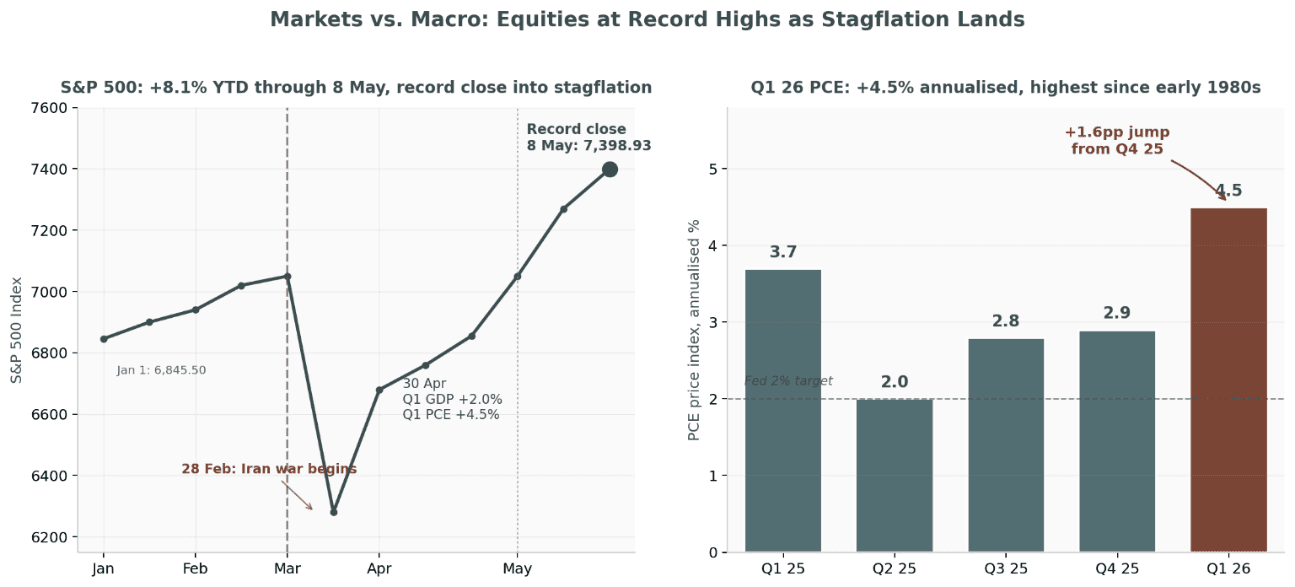
The dominant tail risk has shifted from the Iran shock to its second-order effects. The US-Iran ceasefire from 8 April still holds officially, with a 14-point US MOU under Iranian review via Pakistan, but daily skirmishes (US fire on Iranian tankers, UAE attacks intercepted, Bandar Abbas strikes 7-8 May; CNBC, CENTCOM) keep Hormuz effectively closed. The IEA has called this the most severe oil supply shock in its records, with Director Fatih Birol describing it as the largest energy crisis the world has ever face. IEA estimates ~14 mb/d removed from global supply, Hormuz flows down to 3.8 mb/d (April) from 20+ mb/d (February). The S&P 500 at record highs alongside 4.5% Q1 PCE, with FactSet putting Q1 net profit margin at a record 13.4%, is the market making a binary bet that the Fed under Warsh cuts before stagflation entrenches. That bet is not obviously wrong, but it is not free.
Key Takeaways
- Stagflation in US hard data: Q1 GDP advance +2.0% vs 2.3% consensus (BEA); Q1 PCE +4.5% annualised, core PCE +4.3%. ISM Mfg Prices 84.6 (highest since April 2022); ISM Services Prices 70.7 (4-yr high). The textbook stagflation combination has arrived in official numbers, not just surveys.
- ECB hawkish shift: held at 2.00% on 30 April but stated "upside risks to inflation and downside risks to growth have intensified" (ECB). Markets price ~50bp of hikes by year-end, ~75% probability of a June hike (Polymarket). Cipollone flagged rising hike likelihood 6 May. Regime shift from the "Bright Spot at neutral" March/April framing.
- Highest FOMC dissent in 33 years: 8-4 split on 29 April (Federal Reserve). Miran dissented for a 25bp cut; Hammack, Kashkari and Logan dissented against the "easing bias" in the statement, not against the hold. Powell's Chair term ends 15 May; Senate Banking approved Warsh 13-11; full-Senate vote expected week of 11 May.
- Hungary transition: Magyar sworn in as PM 9 May after Tisza's 141-of-199-seat supermajority on 12 April. Removes the EU's most consistent internal veto; opens path on ~€17bn of frozen funds (incl. €10.4bn RRF, end-August deadline).
- Equities at record highs into stagflation: S&P 500 closed at 7,398.93 on 8 May, longest weekly streak since 2024; FactSet puts Q1 net profit margin at a record 13.4%, forward P/E at 20.9 (vs 5y avg 19.9). Markets are betting Warsh cuts before stagflation entrenches. A binary call, not a free one.
Market Sentiment & Asset Overview
Cross-asset dynamics have detached from US macro fundamentals to a degree that should make any allocator uncomfortable. The S&P 500 closed at a record 7,398.93 on 8 May, with S&P and Nasdaq both posting six straight weekly gains, the longest streak since 2024. This alongside Q1 US PCE +4.5% annualised, an FOMC split 8-4, an ECB flagging "intensified" upside inflation risks, and an active US-Iran skirmish around Hormuz. The market is pricing a clean Warsh cut narrative; the data is pricing stagflation constraining every G3 central bank simultaneously.
The most informative cross-asset signal is the dollar. Despite Q1 PCE well above target, an active war near 20% of seaborne oil flow, and an FOMC openly divided, DXY is at ~97.9 and EUR/USD near 1.18, the highest since 20 April (Trading Economics). That combination historically produces a textbook dollar bid (cf. 2022 Russia, 2020 COVID). It hasn't. Markets price a US fiscal/political trajectory no longer the unambiguous safe haven (Fitch flagged that the US fiscal position will deteriorate in 2026 due to the One Big Beautiful Bill Act tax cuts) and an ECB shifting hawkish. Gold at ~$4,720/oz remains elevated but off its March peak. VIX at 17.19 near multi-month lows. On 8 May, Burry likened the setup to "the last months of the 1999-2000 bubble" (CNBC).
| Asset Class | Current Level | Change | Signal |
|---|---|---|---|
| S&P 500 | ~7,398 | +8.1% YTD | ↑ All-time high; 6-week win streak |
| Euro Stoxx 50 | ~5,973 | +3.1% YTD | ↑ ECB hike-priced rally |
| 10Y UST Yield | ~4.38% | +7bp MoM | ↑ Sticky inflation premium |
| DXY (USD Index) | ~97.9 | -0.2% MoM | ↓ No safe-haven bid |
| Brent Crude | ~$101.29/bbl | +$4 / +4.4% MoM | ↑ +66% YTD vs Jan 1 close $60.85 |
| Gold | ~$4,720/oz | -$28 / -0.6% MoM | ↑ Elevated; off March peak |
| VIX | ~17.19 | -2pts MoM, multi-month low | ↓ Complacency / Burry warning |
| BTC/USD | ~$80,100 | +7.7% MoM | ↑ Stabilising |
Business Cycle Positioning
The April PMI prints confirm the global cycle is converging from the top down. The Eurozone composite slipped to 48.6 (HCOB/S&P Global), the first contraction in 15 months, with services at 46.9 and manufacturing at 52.2 (strongest since May 2022, inflated by defence/infrastructure stockpiling); Germany 48.3. In the US, ISM Manufacturing held at 52.7 (ISM, 1 May) but prices-paid spiked to 84.6 (highest since April 2022, +6.3pp); employment contracted to 46.4. ISM Services held at 53.6 with prices-paid at 70.7 (4-year high) and employment at 48.0, a second straight contraction.
The US stagflation thesis is confirmed in official numbers, not just surveys. Q1 GDP advance +2.0% vs 2.3% consensus (BEA, 30 April), Q4 2025 revised to +0.5%; Q1 PCE +4.5% with core PCE +4.3%. Composition flatters the headline: federal compensation snapback post-shutdown plus AI-driven private investment account for a meaningful share. China holds at composite PMI ~51 with services resilient, but $90+ Brent makes the world's largest net oil importer share the US headwind direction. Japan's manufacturing PMI at a 45-month high with wage growth above 3%, BoJ normalisation prerequisites met, policy rate at 0.75%
| Region | Cycle Phase | Key Indicator | Direction |
|---|---|---|---|
| USA | Late Cycle / Stagflation Risk | Q1 GDP +2.0%; Q1 PCE 4.5% ann.; UE 4.3% | ↓ Deteriorating |
| Eurozone | Mid-Cycle, Hawkish Pivot | HICP April 3.0%; Composite PMI 48.6 (Apr) | → Stalling, hawkish ECB |
| China | Subdued Recovery | Composite PMI ~51; oil headwind | → Stable |
| Switzerland | Moderate Expansion | KOF baseline 1.0%; CPI 0.6% (Apr); CHF firm | → Neutral |
| Japan / Asia ex-CN | Recovery | Mfg PMI 45-mo high; wages >3%; rate 0.75% | ↑ Improving |
| Emerging Markets | Mixed / Diverging | Commodity exporters vs net importers | ↓ Diverging |
Special Focus: Stagflation Confirmed in Hard Data — Q1 GDP Beat, Sticky Inflation & Fed Succession
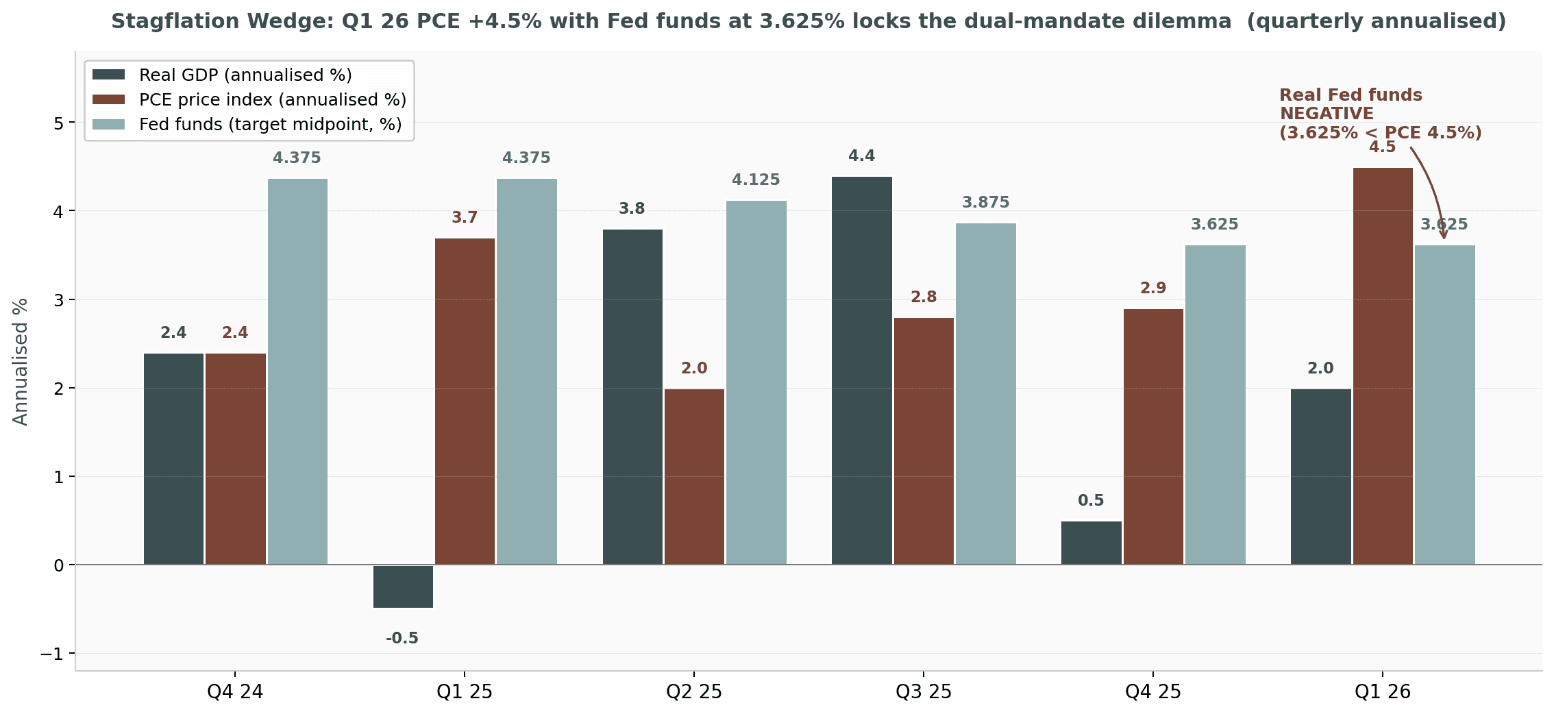
The 30 April Q1 GDP advance at +2.0% annualised marked stagflation's formal arrival in US official data. The headline missed 2.3% consensus, but Q1 PCE ran at +4.5% with core PCE at +4.3%. This is the first time since the early 1980s that a single quarter has paired sub-trend growth with inflation more than double the Fed's target. Composition matters: federal compensation snapback post-shutdown plus AI-driven private investment account for a meaningful share, so underlying private demand is weaker than the headline. Q4 2025 was simultaneously revised to +0.5%.
Supporting indicators tell the same story. ISM Mfg held at 52.7, prices-paid jumped 6.3pp to 84.6, employment contracted to 46.4. ISM Services 53.6, prices-paid 70.7 (4-yr high), employment 48.0 (second consecutive contraction). April NFP +115K beat ~55K consensus (BLS, 8 May); March revised to +185K, Feb to -156K; UE 4.3%; AHE +3.6% YoY. Input and consumer prices firming, hiring softening, wage-price reflexivity intact.
The FOMC's 29 April decision (Federal Reserve) to hold at 3.50-3.75% with an 8-4 split, the highest dissent since October 1992, is the institutional confirmation. Miran dissented for a 25bp cut; Hammack, Kashkari and Logan dissented against the inclusion of an "easing bias" in the statement, preferring a neutral stance. The Committee no longer agrees on the direction of the next move. That is the operating definition of policy paralysis. Powell's Chair term expires 15 May; Warsh was approved 13-11 by Senate Banking on 29 April, full-Senate confirmation expected the week of 11 May; Powell remains on the Board of Governors. Markets pricing equities at record highs assuming Warsh is more dovish than Powell ignore his on-record 2010 hawkish dissent. The joint probability that "equities at record highs" and "next Fed move is a cut" both prove wrong is the underpriced risk of summer 2026.
Regional Overviews
The regional picture is defined by central-bank divergence on top of a common stagflationary shock. The US is paralysed at 3.50-3.75% with a Fed Chair handover due 15 May; the Eurozone has flipped to market-priced 50bp of hikes by year-end; Switzerland sits at zero with the franc still bid as the only G3 disinflation story. Presented in order of analytical priority from our Swiss home base.
United States
Growth — US Q1 2026 GDP advance +2.0% vs 2.3% consensus (BEA, 30 April); Q4 2025 revised to +0.5%. Composition is the warning: federal compensation snapback post-shutdown plus AI-driven private investment account for a meaningful share, so underlying private demand is weaker than the headline. April NFP +115K beat a ~55K consensus (BLS, 8 May); March revised up to +185K, Feb to -156K; UE 4.3%, AHE +3.6% YoY; labor force participation slipped to 61.8% from 61.9%. ISM Services employment in second consecutive contraction. UMich May sentiment near June 2022 low.
Monetary Policy — The 29 April FOMC held at 3.50-3.75% with an 8-4 split, the largest dissent since October 1992 (Federal Reserve). Miran dissented for a 25bp cut; Hammack, Kashkari and Logan dissented against the statement's "easing bias," not against the hold. Fed futures price ~8bp of cuts by year-end. Powell's Chair term ends 15 May; Senate Banking approved Warsh 13-11 on 29 April (first fully partisan vote on a Fed Chair); full-Senate vote expected week of 11 May. Powell remains on the Board of Governors.
Key Risk / Watch — April CPI on 12 May is the immediate test (Cleveland nowcast 3.56%). Watch the full-Senate Warsh vote and first remarks from the chair-designate. Core risk: a Warsh communication slip, either too dovish (recommitting complacency) or too hawkish (puncturing the record-highs trade).
Switzerland
Switzerland is the only major economy where disinflation, not stagflation, is the live discussion. This is a function of currency strength and energy import diversification, not domestic resilience. The export side is under pressure.
Growth — KOF's baseline 2026 GDP forecast at 1.0% (oil-shock alt 0.7%), narrower than April's 1.1-1.9%. April CPI +0.6% YoY (FSO, 5 May; highest since Dec 2024), core +0.3% (softest since July 2021). EUR/CHF closed at 0.9154 on 8 May (year low 0.9003 on 8 March). Novartis and Roche (combined cap > CHF 400bn) absorb earnings compression from CHF strength. The global inflation anomaly: US CPI 3.3%, Eurozone HICP 3.0%, Swiss CPI 0.6%.
Monetary Policy — The SNB remains at 0.00%; next scheduled decision 18 June. Schlegel has flagged increased intervention readiness. The SNB sits structurally close to the zero lower bound, below which negative-rate optionality re-enters the discussion at meaningful cost to banking-sector NIMs post-Credit Suisse. Primary near-term lever: FX intervention, not rate cuts.
Key Risk / Watch — EUR/CHF at 0.9154 already trades inside the 0.90-0.92 range that historically prompts SNB action. The decisive cross-current is the hawkish ECB pivot. If markets keep pricing 50bp of ECB hikes while Switzerland holds at zero, the rate differential supports EUR/CHF and does part of the SNB's job. Monitor Schlegel commentary ahead of 18 June.
Eurozone
The Eurozone narrative has flipped twice in two months: from "Bright Spot at neutral" (Mar/Apr) to "hawkish pivot priced for June" (May). Q1 GDP +0.1% q/q, April HICP 3.0% (highest since Sep 2023), April composite PMI in contraction. The bloc is no longer disinflating, and the ECB has noticed.
Growth — Q1 GDP advance +0.1% q/q, +0.8% y/y (Eurostat). Germany +0.3%, France stalled, Italy +0.2%. April composite PMI flash 48.6 (first contraction in 15 months); services 46.9 with a 10-month confidence low; manufacturing 52.2 (strongest since May 2022, inflated by defence/infrastructure stockpiling); Germany 48.3. Euro Stoxx 50 at 5,973 on 8 May (+3.1% YTD from Jan 1 close 5,791); Hungarian reset (Magyar sworn in 9 May) clears path on ~€17bn of frozen EU funds, incl. €10.4bn RRF (end-August deadline).
Monetary Policy — The ECB held at 2.00% deposit (2.15% MRO, 2.40% marginal) on 30 April (ECB), with the statement noting "upside risks to inflation and downside risks to growth have intensified." Markets price ~50bp of hikes by year-end with ~75% probability of a June increase (Polymarket). On 6 May in Milan, Cipollone said "the current situation seems to be drifting away from our March baseline projections, which increases the likelihood that we may need to adjust our policy rates" (Reuters). JP Morgan and Barclays forecast 25bp hikes in June and September.
Key Risk / Watch — The June ECB meeting is the binary event. A hike confirms the regime shift; a hold resets rates sharply lower and weakens EUR/USD 1-2 figures. Secondary risk: Hungary's ability to deliver €10.4bn RRF milestones by end-August. The Commission is sceptical the full envelope is achievable.
China
Growth — China at composite PMI ~51, services resilient, manufacturing stable. As the world's largest net oil importer, China shares the US growth-headwind direction rather than the commodity-export windfall of Gulf states or Brazil. Domestic deflation persists; property remains a structural drag.
Monetary Policy — The PBOC maintains an easing bias via cross-cyclical tools. Fiscal stimulus remains constrained by debt-sustainability concerns. A sustained $95-105 Brent range is a material headwind; US-China semiconductor controls remain a medium-term overhang.
Key Risk / Watch — Domestic deflation compounded by external energy shock. Monitor May Caixin/NBS PMI, NPC supplementary budget announcements, and CNY-USD reaction to the Warsh confirmation.
Japan & Asia ex-China
Growth — Japan's manufacturing PMI at a 45-month high; wage growth above 3% meets BoJ normalisation prerequisites. USD/JPY at 156-157 (suspected Tokyo intervention 8 May) is double-edged: supportive for exports, feeding imported inflation at $100+ Brent. US consumer softening is a secondary headwind for Asia ex-China exporters.
Monetary Policy — BoJ policy rate sits at 0.75% with JGB yields rising more freely post-YCC exit. A disorderly yen depreciation beyond 160 vs USD could force emergency BoJ action, a repeat of the August 2024 carry-trade unwind when VIX spiked to 64.
Key Risk / Watch — JPY trajectory is the key variable. Monitor BoJ guidance, USD/JPY around the Warsh confirmation, and further intervention disclosures.
Emerging Markets
Growth — The EM complex remains in its sharpest divergence since 2014-16: Brazil, GCC states, and Nigerian energy names benefit from sustained $95+ Brent; ASEAN, South Asia and African oil importers face deteriorating terms of trade and potential BoP stress. The Hungarian forint strengthened ~4% to a 4-year high vs EUR on the Magyar win. An early signal of political-risk premium repricing in CEE.
Monetary Policy — Brazil's BCB hiking; India's RBI cautiously neutral; ASEAN broadly accommodative. Sustained $95+ Brent creates upward inflation pressure across the board. The dollar's failure to rally on the Iran shock has been quiet relief for dollarised-debt EMs, contingent on Warsh not delivering a hawkish surprise post-confirmation.
Key Risk / Watch — Monitor EM sovereign spreads, particularly frontier markets with heavy oil-import exposure. Long GCC equities and Brazilian energy names are the most direct Brent exposure. FSB private-credit warning (6 May): EM credit funds with private-credit allocations exposed to forced liquidation if DM spreads widen.
Outlook & Key Risks
Base Case (55%): Iran ceasefire continues to hold despite ongoing skirmishes; the 14-point US MOU yields a partial Hormuz reopening over Q2. Brent settles in $90-105. Warsh confirmed mid-May, inherits the FOMC's 8-4 split; Fed holds at 3.50-3.75% through Q3 with one 25bp cut possible in Q4 if core PCE moderates from 4.3%. The ECB delivers a 25bp hike in June, then pauses. US GDP tracks 1.0-1.5% annualised in Q2/Q3. EUR/USD holds at 1.16-1.20; Gold above $4,500; VIX rises into 18-22 as complacency normalises.
Upside Risks (25% probability) — Iran accepts the 14-point US MOU; Hormuz reopens, blockade lifted. Brent retreats to $75-82, breaking the inflation pass-through. Q2 PCE prints below 3%, restoring Fed cut optionality under Warsh. ECB hikes in June but signals a clear pause. Eurozone benefits most: German fiscal expansion plus lower energy costs delivers genuine mid-cycle acceleration. EUR/USD tests 1.20-1.22; Gold corrects to $4,200-4,400; S&P 500 extends +5-8%.
Downside Risks (20% probability) — Iran ceasefire collapses; Brent returns to $110-120+; US CPI breaches 4% and core PCE stays above 4%. Warsh, in his first FOMC, faces a hike decision. Delivering it punctures the record-highs trade, holding punctures his credibility. The FSB private-credit warning materialises into forced liquidations as DM spreads widen. EUR/USD reverses to 1.10-1.12; Gold re-tests $5,000; S&P 500 corrects 12-18%.
| Metric | Base Case (55%) | Upside (25%) | Downside (20%) |
|---|---|---|---|
| Brent Crude | $90-105/bbl | $75-82/bbl | $110-120+/bbl |
| S&P 500 | Flat to +5% | Rally +5-8% | -12 to -18% |
| Fed Path | Hold; one Q4 cut possible | 1-2 cuts H2 2026 | Hold / possible hike |
| EUR/USD | 1.16-1.20 | 1.20-1.22 | 1.10-1.12 |
Key Dates & Events
| Event | What to Watch |
|---|---|
| Week of 12 May, Warsh full-Senate vote | Confirmation expected after the 13-11 committee vote on 29 April. Watch for pre-confirmation public remarks. |
| 12 May, US CPI April | Cleveland Fed nowcast 3.56%. >3.5% locks the Fed into hold; <3.2% reopens the cut path. |
| 15 May, Powell term ends | Will Powell remain as Fed Governor? Warsh expected to take over as Chair. The communication transition itself is the market event. |
| 11 June, ECB | Markets price 75% probability of a 25bp hike to 2.25% deposit. A hold would re-rate EUR/USD sharply lower. |
| 8 June, FOMC | First decision under the post-Powell Chair. Watch for rate-path guidance in the SEP and Warsh's first press conference. |
| 17 June, SNB | EUR/CHF at 0.9154 already inside the historical 0.90-0.92 SNB-action range. Watch for explicit intervention threshold language. |
Prepared by Tristan Sommer · Investment Club Zurich — Macro Team · 11 May 2026 · Sources: BEA (Q1 GDP advance, 30 April 2026), BLS (Employment Situation April 2026; CPI March 2026), Federal Reserve (FOMC, 29 April 2026), ECB (30 April 2026), SNB (data.snb.ch), ISM (April 2026), S&P Global / HCOB Eurozone PMI Flash, Eurostat, USDA NASS, KOF, FactSet, FSB (6 May 2026), CNBC, Reuters, Bloomberg, FT, Yahoo Finance, FRED / St. Louis Fed.